
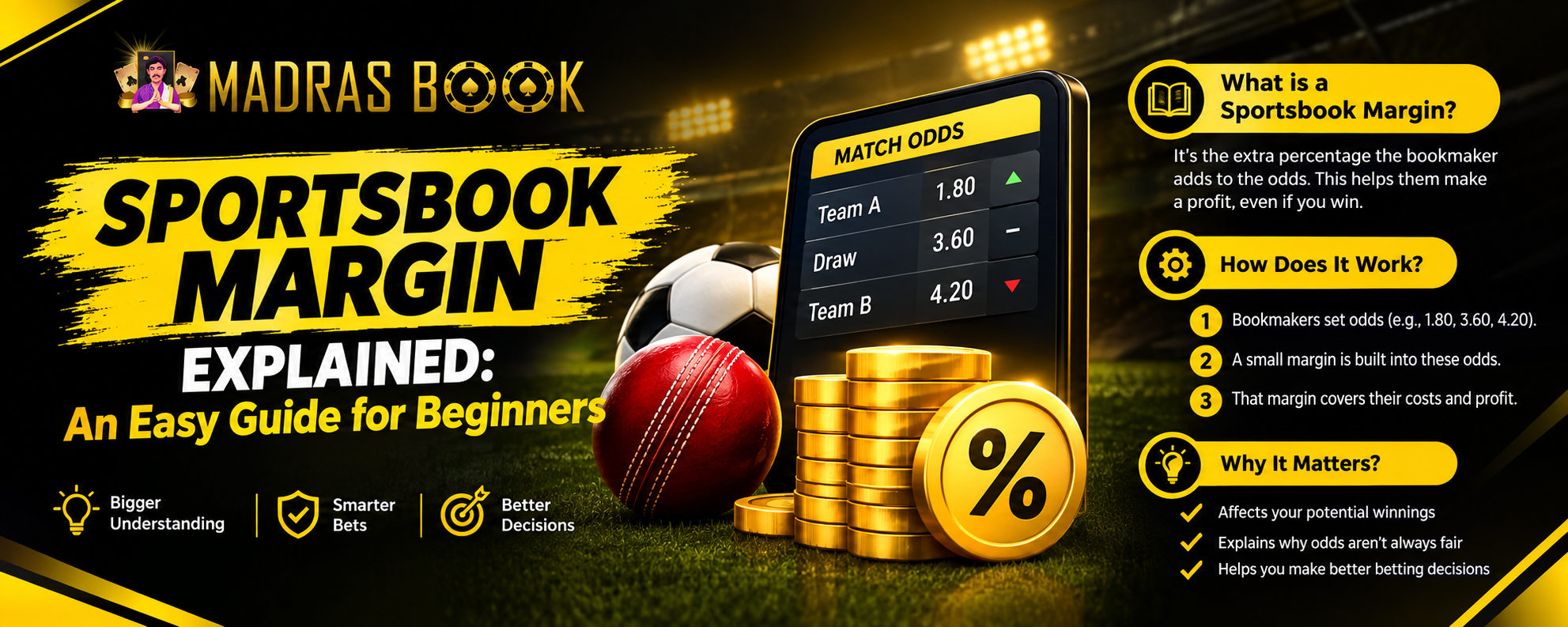
Beginners can read odds more carefully by understanding how betting platforms make money. One of the main ideas behind this system is Sportsbook Margin. It’s the percentage that a bookmaker adds to betting odds to create a mathematical advantage for the sportsbook over time. Knowing terms like sportsbook profit margin, betting margin and other Cricket book ID related terms can help to make sports betting terminology easier to understand. This guide offers an easy explanation of the concept and also covers how Madrasbook may be considered when researching online sports and gaming information.
What Is Sports Betting Margin?
The Sportsbook Margin is the difference between implied probabilities in the betting odds and a theoretical fair market, where the sum of probabilities is exactly 100%. This extra percentage is usually built into the odds by bookmakers to guarantee they make a profit no matter which outcome occurs, assuming their pricing and risk management are working as intended.
For example , say you have an event with two outcomes and both would have a fair probability of 50% . The fair decimal odds would be 2.00 each way. If a bookmaker offers 1.90 odds on both outcomes, then the implied probabilities are about 52.63% for each outcome. Together, they make up about 105.26%. The extra 5.26% is approximate bookmaker margin in this simplified example.
That’s why it can be useful to compare odds at different sportsbooks. Even minor changes in prices can influence possible return on bet.
What is Bookmaker Margin?
The bookmaker then applies statistical models, market information, team news, player availability and other factors to calculate the probability of each possible outcome. Then it marks up the prices to give it its desired margin.
The odds available to customers reflect the resulting bookmaker margin. A lower margin generally means the odds offered are closer to the implied fair probabilities . A higher margin means a larger built-in difference .
Sportsbook Margin is not always a specific charge that shows up on a betting slip, but it is helpful for beginners to know that. Instead, it is usually built into the odds themselves.
Sportsbook Margin and Betting Odds
Sportsbook margin versus betting odds margin. Odds tell you what you could win, but the margin is the mathematical advantage baked into those prices.
Take a simple market with three outcomes. A bookmaker may offer odds of 2.50, 3.20 and 3.00 on the selections. If you convert these decimal odds to implied probabilities and add them up you get a percentage >100%. The amount over 100% is a common measure of the market’s overround or margin.
This computation can be written as:
Implied Probability = 1 / Decimal Odds * 100
Add up the implied probabilities for all the selections to get an approximate market percentage. Anything over 100% is the margin built in.
Sportsbook Hold Vs Margin
The terms sportsbook hold and Sportsbook Margin are related but not always the same.
The sportsbook hold is typically the percentage of money wagered that a sportsbook keeps after paying winning bets over a period of time or market. If customers bet ₹ 100,000 and the sportsbook ends up keeping ₹ 5,000, the hold would be 5%.
The actual hold can vary quite a bit depending on how customers bet and what transpires.” In contrast, it is the pricing advantage built into the odds before the events are known.
This is an important distinction, because a sportsbook might have a certain theoretical margin, but then a different actual hold for a particular event or time period.
Why Sportsbook Margin is Important for Beginners
Knowing the sportsbook margin can help you read the odds, rather than the potential payout. Two sportsbooks can have different prices on the same match because they have different models, risk management, competition in the market and margins.
For example, if one platform offers odds of 1.85 and another offers 1.95 for the same outcome, the second price offers a different potential return for the same bet. Users should also take into account the market rules, settlement terms, fees, account requirements and applicable laws.
Anyone who researches sports-related platforms will come across terms like Online Game ID and other account terminology. They may refer to access credentials or platform services . They should not be confused with margins in the mathematical sense .
Sportsbook margin in Various Sports
The sportsbook margin will depend on the sport and market. When a major sport has a lot of betting volume, the prices tend to be very competitive as there are several bookmakers fighting for your business.
Pricing structures could vary for popular markets such as football match results, cricket match winners, tennis, basketball and other established events. In less popular markets or smaller leagues, wider margins are sometimes possible due to less market information and competition.
Cricket markets can include a host of options such as match winners, totals, player related markets and other event specific selections. A person considering an ID Game Online service should examine its terms and regulatory status separately, rather than assuming that an account ID means anything about pricing quality.
Sportsbook Margin And Vig
Typically, the bookmaker’s built-in advantage is called the sportsbook vig, short for vigorish. In many contexts sportsbook vig and margin are used to refer to the same general concept of pricing.
The difference between the two sides priced below their fair odds gives the bookmaker a mathematical advantage. This is part of the reason that consistently profitable betting is hard. The bettor usually starts from odds that already contain a bookmaker advantage.
Knowing it does not mean you will win more bets. It just makes the picture of how the betting prices are set up clearer.
How to Compare Margins at Sportsbooks
A basic comparison can start with a single market across different sportsbooks. Save the odds for the same selections and convert these to implied probabilities.
See differences in:
1. Odds in decimal format
2. Market picking
3. Expected pot odds
4. Projected Margin
5. Minimum and maximum bets
6. Settlement rules
7. Fees or transaction terms
8. Account and Verification Needs
Online Game ID Cricket service users should also check what the platform provides before creating an account. Similarly, a Cricket Book ID could be about access terminology rather than a signal of lower margins.
Sportsbook Margin & Madrasbook
Madrasbook can be added to research when users are searching for online sports and cricket related platforms. New users should not only read the hype when considering any platform , but also understand how the odds , markets , account requirements , withdrawals and responsible-use policies work .
When you choose a Genuine Online Cricket ID, you should look for transparent information on the service, rules, account security and terms. Users should also independently check the availability of a service in their jurisdiction.
The concept of Sportsbook Margin is platform-agnostic because it’s based on the math of how odds are structured and not the name of the brand.
A Simple Example:
Consider a bookmaker with two outcomes at odds of 1.80 and 2.00.
The implied odds are:
1 ÷ 1.80 = 55.56%
1 ÷ 2.00 = 50%
Total 105.56%.
So the theoretical margin is something like 5.56%.
This example is a good example why Sportsbook Margin is sometimes called the percentage added to a market. It also explains why the choice of the more probable outcome does not eliminate the mathematical advantage of the bookmaker.
Thus, users should separate account access from pricing analysis when researching a MadrasBook Online ID. A service is an ID; margin analysis is the analysis of prices in a market.
Understanding the Margin Before You Use Betting Markets
Another way to interpret it is to view it as part of the costs embedded in the odds. A financial exchange can have a spread between buying and selling prices, and betting markets can have a spread between fair probabilities and bookmaker prices.
When people are looking for an Online Cricket ID Provider they might encounter a lot of different services and promotional claims. Clear terms and an understanding of the odds might be more helpful than just listening to advertising.
Similarly, Sportsbook Margin should be considered in conjunction with market liquidity, odds movement, limits, settlement rules and the reliability of the platform.
Sportsbook Margin and the Math in the Long Run
The theoretical margin of the bookmaker is a component of the expected revenue of the bookmaker over a large number of markets . But there are no guaranties regarding achieving results – sport is unpredictable.
A sportsbook can have a positive theoretical edge and still lose on any given event. However, a single punter can still win a particular bet, despite a bookmaker margin.
And this is why Sportsbook Margin should be thought of as a mathematical pricing idea rather than a promise of what will happen on any one bet.
Conclusion
A concept that is very useful for beginner bettors is the Sportsbook Margin, which helps you understand how betting odds are priced. It explains why the implied probabilities in a market often add up to more than 100% and the way in which bookmakers build a mathematical edge into their prices.
Understanding sportsbook profit margin, betting margin, bookmaker margin, betting odds margin, sportsbook hold and sportsbook vig all help in understanding betting markets. Review research platforms like Madrasbook for Madrasbook Online ID, as well as applicable laws, account terms, security procedures and responsible-use information.
Ultimately, it’s about understanding the math behind the odds, not about predicting sports outcomes. A good understanding of the concept can help beginners read the betting markets more critically, and make better decisions about the information they see.
Frequently Asked Questions (FAQs)
1. What is Sportsbook Margin?
The built-in edge of a bookmaker’s odds over the theoretically fair probability of a market.
2. How to calculate Margin of Sportsbook?
Convert each decimal odd to an implied probability as 1 divided by the decimal odd. Add up all the probabilities. How does this compare with 100%?
3. Is Sportsbook Hold Same As Margin?
Not really. It is the theoretical edge in pricing. The sportsbook hold is typically used to describe the actual amount held from betting activity over a period of time.
4. What is vig in sportsbooks?
Vigorish is the built-in percentage or inherent edge that the bookmaker has . Sportsbook vig is a common term . It is closely related to the margin built in to the odds of a bet.
5. Why does Sportsbook Margin change?
Margins may differ depending on the market size, the competition, the sport, the liquidity and the pricing model and risk-management approach of the bookmaker.
